File 004 GRD // Grid Down & EMP
What Happens If the Power Grid Goes Down: Hour by Hour
A long blackout fails in a set order: phones, water, fuel, food, medicine. Here is the hour-by-hour timeline from real outages and what to do at each stage.
Lab verdict
In a wide-area blackout, phones degrade within hours, water pressure and fuel pumps fail within a day, food spoils in two to three days, and medical and sanitation problems build after that. Most real outages end in hours to days. Rare ones, like Puerto Rico after Hurricane Maria, ran for months because equipment was destroyed.
Key findings
- Real US blackouts lasted hours to about four days (2003 Northeast, 2021 Texas). Puerto Rico after Maria took up to 328 days for the last neighborhood.
- Things fail in a predictable order: cell service, water pressure, fuel pumps, refrigeration, then sanitation and medical care.
- A fridge holds safe temperature about 4 hours; a full freezer about 48 hours (Ready.gov).
- The biggest killers in recent outages were cold and carbon monoxide, not hunger.
- Water, a heat plan, a battery radio and a medication plan cover most of the risk.
MythA grid-down event means months of darkness everywhere.
EvidenceThe 2003 Northeast blackout hit about 50 million people and some areas were out for up to four days. Months-long outages need physical destruction of lines and plants, as in Puerto Rico in 2017.
MythA generator in the garage with the door open is fine.
EvidenceReady.gov says to run generators outdoors at least 20 feet (6 m) from windows, doors and attached garages, because of carbon monoxide.
What happens if the power grid goes down across a large region? The first thing you lose is not light. It is information. Cell networks overload, then fade, and within a day the systems that move water, fuel and food start to stall behind them.
How bad it gets depends almost entirely on how long it lasts. The United States has had a handful of large blackouts in recent memory, and they give a usable picture. Most ended in hours or days. One lasted most of a year. This article walks through what fails, in what order, and what to do at each stage.
We built the timeline from official reports and measured outages, not from movie scenarios. Where we are estimating, we say so.
What the real blackouts tell us
Three events set the range. Each one failed for a different reason.
August 2003, Northeast and Ontario. About 50 million people lost power. According to the U.S.-Canada Power System Outage Task Force, the cascade started when an overloaded FirstEnergy line contacted trees and tripped, and operators did not understand what was happening to their system. Some US areas were without power for four days, and Ontario had rolling blackouts for more than a week. US cost estimates ran from $4 billion to $10 billion. The report concluded the blackout was preventable.
February 2021, Texas. Winter Storm Uri froze gas supplies and generators. The FERC-NERC final report found that ERCOT ordered 20,000 MW of rolling blackouts to avoid a full grid collapse, the largest manually controlled load shed in US history. Per law-firm summaries of that report, more than 4.5 million people lost power, some for up to four days. Freezing caused 44.2% of unplanned generator outages and fuel problems 31.4%. The Texas health department’s final count was 246 deaths, and about 65% involved cold exposure.
September 2017, Puerto Rico. Hurricane Maria wrecked poles, lines and substations. The last neighborhood got power back 328 days later. A Rhodium Group analysis put the loss at 3.4 billion customer-hours, the largest US blackout on record.
The pattern: when the problem is software, weather or a tripped line, grids come back in days. When hardware is physically destroyed, restoration takes as long as it takes to rebuild.
Why one failure spreads
The lower 48 states run on three main interconnections: Eastern, Western and ERCOT in Texas. Inside each one, every generator spins in lockstep with the same frequency. That is efficient, and it is also how a fault travels. If supply and demand fall out of balance, plants trip themselves off to protect their equipment, and each trip makes the imbalance worse.
The three interconnections mostly operate independently and rarely transfer power between them. That limits how far a cascade can run. It also limits how much help the neighbors can send.
How the grid is restarted
You cannot restart a large power plant without electricity. So operators keep a few “black start” units: small diesel or gas generators, and hydro plants that can start from nothing. They energize a chosen route of transmission lines (a cranking path), which gives the next, bigger plants enough power to start. Then load is added in small blocks, because adding too much at once can collapse the system again.
A FERC-NERC staff study concluded operators have enough black start capability, with a warning that availability is falling at some utilities as older units retire. This is why a well-run restart takes hours to days, not minutes.
Hour-by-hour timeline
This table is a planning model, not a measurement. Times shift with weather, region and how many people are affected at once. Phone and fuel behavior is partly our estimate; the food figures are from Ready.gov.
| Time | What fails | What to do |
|---|---|---|
| 0 to 1 hour | Lights, elevators, traffic signals, internet. Cell networks flood with calls. | Check on household members. Use text, not voice calls. Switch to flashlights. Skip candles if you can. |
| 1 to 8 hours | Cell sites on battery backup start dropping. Card readers and ATMs fail. Gas pumps stop. | Fill the car’s tank if you are near a working station. Carry a little cash. Keep fridge and freezer shut. |
| 8 to 24 hours | Water pressure falls in many systems. Refrigerator passes its safe window. Hospitals and sewage plants rely on generators. | Fill tubs and containers with water. Eat perishables first. Plan heat or cooling. |
| 1 to 3 days | Fuel at stations runs out. Groceries empty. Freezer contents thaw. Generator fuel runs low. | Cook and use the freezer’s food. Ration fuel. Consolidate into one warm or cool room. |
| 3 to 7 days | Sanitation problems build. Prescription refills run short. Tempers shorten. | Boil or treat water. Set up a bucket toilet. Pool resources with neighbors. |
| 1 week or more | Supply chains stall. Sustained shortages. | Only occurs with physical damage. Move toward a shelter or relatives if officials advise. |
What breaks first, and why
Phones and communications
Cell towers and network sites have backup batteries and some have generators, but backup is sized for hours, not days. In 2007 the FCC adopted a rule for eight hours of backup at cell sites, which carriers fought; the White House budget office rejected it and a court put it on hold in 2008. So backup length varies by carrier and site.
Maria shows the ceiling. FCC reports put about 95% of Puerto Rico’s cell sites out of service at the worst point (1,711 of 1,789 sites on September 22, 2017). That was a hurricane that also destroyed the towers. In 2003, some cell sites went down when their backup generators ran out of fuel, and call volume jammed the rest.
What to do: pick a text-first plan. Agree on a meeting place and a check-in time. A battery-powered or hand-crank radio tuned to NOAA Weather Radio and local AM/FM stations carries official information when phones do not. Our survival gear guide covers radios and battery banks.
Water
Most municipal systems need electric pumps for pressure and treatment. Many have generators and tanks that hold hours of supply, but demand drops the tanks fast. In the 2003 blackout, loss of pressure led to boil-water advisories in several cities, and in Detroit it lasted until August 18.
Expect low pressure, then no pressure, then possible contamination when pressure returns. Fill bathtubs and containers early. The common planning figure is one gallon (about 4 liters) per person per day for drinking and basic hygiene, per Ready.gov’s kit guidance.
Fuel
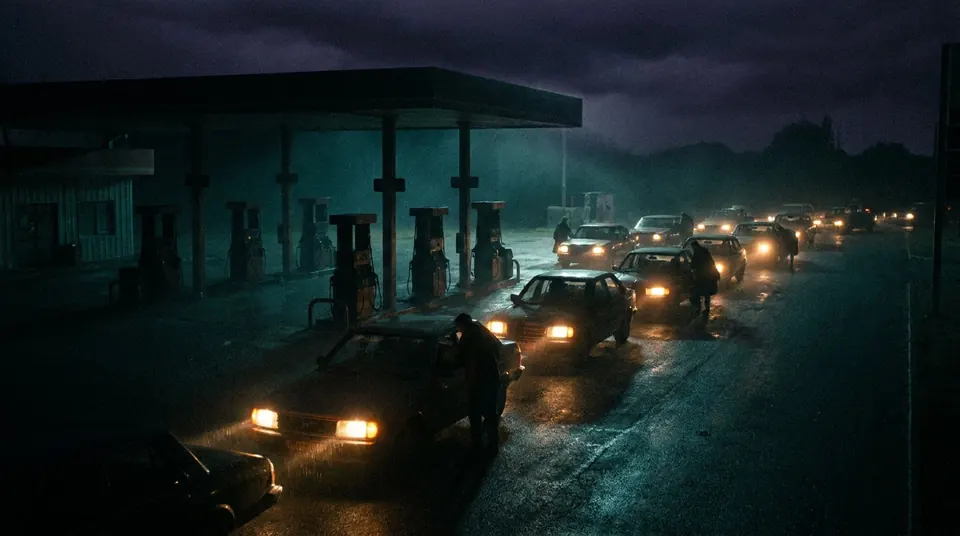
Gas pumps run on electricity. Without power or a station generator, they stop. Stations with generators exist but are few, and demand surges. Trucks that deliver fuel also depend on terminals that run on grid power. This is why a car with a quarter tank in hour one has far fewer options by hour 24.
Food and refrigeration
Ready.gov guidance: a closed refrigerator keeps food cold for about four hours, and a full freezer for about 48 hours (a half-full one for less). Throw out perishable food that has been at 40°F (4°C) or above for two hours or more. The practical order is fridge first, freezer second, pantry last. Stores run out because deliveries stop and card readers fail, not because stock vanishes.
Hospitals and medical needs
Hospitals have generators. How long they run depends on fuel and on resupply. The Joint Commission expects hospitals to plan for 96 hours without outside support, but says this does not mean they must store 96 hours of fuel on site. Home patients are more exposed: oxygen concentrators, refrigerated insulin, powered beds and dialysis at clinics all depend on electricity. Ready.gov tells people with power-dependent devices to ask their provider for a plan before an outage and to discard refrigerated medication left unrefrigerated for more than a day unless the label says otherwise.
Sewage and sanitation
Wastewater systems use lift stations, pumps that move sewage uphill. With no power and no generator, these back up. Toilets flush once from the tank, then not. This is the quiet problem of day three or four, and it is also why household water storage matters beyond drinking.
What actually hurt people
Texas is the best recent data on who gets hurt. About 65% of the state’s counted deaths were from cold exposure, and roughly 9% from vehicle crashes in bad conditions. In long outages elsewhere, the other repeat killer is carbon monoxide from improper generator and stove use.
Heat is the plan to make before the lights go out. Our guide on using a propane heater indoors covers what is safe and what is not. Short rule from Ready.gov: never heat a home with a gas stove or oven, run generators only outdoors, and put battery-backup CO detectors on every level.
Safety: Carbon monoxide has no smell. Do not rely on noticing it. A battery-backup CO alarm is the only warning you get. Our guide to carbon monoxide poisoning symptoms shows what to look for.
Who gets hit hardest
A blackout does not hurt everyone equally. The factors that matter most are health, housing and climate.
- People who rely on powered medical equipment. Oxygen concentrators, home ventilators, powered mattresses and refrigerated medicines all fail on the first day. Ready.gov advises asking your provider for a plan before an outage.
- People in high-rises. Elevators stop. Water in tall buildings is lifted by electric pumps, so upper floors lose water first. This is a mechanical fact of how buildings work, not a measured statistic, but it explains why apartment dwellers tend to run out of options sooner.
- People in extreme climates. Texas in February is the example. The cold, not the dark, killed most of the people who died. Extreme heat is the mirror problem, and our guide on surviving the cold covers the physiology.
- People who depend on a single car or a single phone. Both turn out to be single points of failure.
If you live in an apartment, add a second plan: where you would go if the building became unlivable, and who would take you in. A relative’s house with a wood stove or a working well is worth more than a closet full of gear.
How restoration really goes
Power does not come back all at once, and it does not come back in a fair order. Utilities restore the transmission backbone first, then substations serving hospitals, water plants and emergency services, then large blocks of homes. Neighborhoods at the end of a damaged feeder wait longest. In 2003, New York City had full power by August 16, two days after the blackout began, while some 500,000 Detroit customers were still out on the evening of August 15.
When power returns, a few things go wrong. Appliances can be damaged by surges. Ready.gov advises unplugging or switching off appliances and electronics so they are not hit when power returns. Water may be cloudy or contaminated, and the boil-water advisory may outlast the electricity by days.
What to do, in order
- Hour 0. Confirm it is wider than your house: check the breaker, then look outside. Treat any downed line as live and stay away from it.
- First day. Fill containers with water. Keep fridge and freezer closed. Fill the car. Charge phones and battery banks while you can.
- Day two to three. Consolidate into a single room. Eat perishables. Check on elderly or medically dependent neighbors.
- Day three onward. Treat or boil water. Set up sanitation. Ration fuel for the generator for key loads only (fridge in short cycles, not whole-house).
- Throughout. Be careful about what you advertise. A running generator and a full yard of supplies attract attention. The gray man strategy lays out the reasoning in detail, and OPSEC for preppers shows how to find your own leaks.
A three-day kit that covers the real events
Both the 2003 and 2021 outages lasted about four days at the worst. A kit sized to that handles most of the history. Ready.gov’s basic kit guidance is the baseline: at least a three-day supply of food and water, a battery or hand-crank radio, flashlights, extra batteries, a first-aid kit and a way to charge phones.
Add what the real events teach:
- A water plan. One gallon (about 4 liters) per person per day, plus a way to treat more.
- A heat plan for your climate. Layers, sleeping bags and one room you can keep warm. Do not use cooking appliances as heaters.
- A CO alarm with battery backup, on every level.
- Fuel discipline. Keep the car above half a tank as a habit.
- A medication buffer and a note of your prescriptions.
- Paper copies of key phone numbers and a local map.
Our survival gear guide separates the items that matter from the ones that do not.
Could the grid fail for months?
Yes, under specific conditions, and none of them are routine. A hurricane that destroys distribution networks is one. A solar superstorm that damages large transformers is another, covered in the Carrington event today. A high-altitude nuclear burst is a third, though experts disagree on how long it would last: see what an EMP does. Each of these is a low-probability, high-consequence event, and our estimates of likelihood are in those articles.
For everyday planning, the three-to-four-day blackout is the realistic scenario. Prepare for that first. Anything longer is the same list with more water and more patience.
Lab verdict
A grid collapse is survivable for most people if they have water, a heat plan, a way to get information and a medication plan. The risks are cold, carbon monoxide and dehydration, in that order of recent body counts. Hunger is not the first problem.
Three days of preparation covers the three biggest real events on record. If you can store more, store water first.
Frequently asked questions
What happens if the US power grid goes down completely?
A complete shutdown of one interconnection would mean no power for most customers until black start units rebuild the grid in stages. Communications, water pressure and fuel pumps fail within hours to a day. Past large blackouts lasted up to about four days. A longer outage needs physical destruction of equipment.
How long would society last without power?
There is no single answer. In the 2003 and 2021 events, order held for the full outage. Strain grows quickly after three to four days, when water, fuel, sanitation and medicine become problems. Nobody has a tested measure for a wide-area outage beyond a week. Puerto Rico shows the human cost of months, but it was a single island.
What should I do first if the power goes out?
Check whether it is only your house. Keep the fridge and freezer closed. Use flashlights. Fill containers with water. Text instead of calling. If it is cold, set up your heat plan now. Follow local officials and listen to a battery radio for restoration estimates.
How long does food last in a power outage?
A closed refrigerator keeps food cold for about four hours. A full freezer holds for about 48 hours, a half-full one less. Discard perishable food that has been above 40°F (4°C) for two hours or more. Use a thermometer rather than guessing.
Will ATMs and credit cards work?
Usually not for the length of a wide blackout. Card readers need power and a network link. Some stores run offline systems or cash. Keep a small amount of cash in small bills. This is general planning advice, and we found no official figure for how long payments stay down.
Can the grid go down from a solar storm?
Yes, regionally. A March 1989 storm collapsed Quebec’s grid in under 90 seconds and left about 6 million people without power for about nine hours. Whether a much larger storm could cause longer outages is covered in our Carrington event article.
Sources
- U.S.-Canada Power System Outage Task Force final report, via DOE
- FERC: Final report on February 2021 freeze
- Norton Rose Fulbright summary of the FERC-NERC Uri report
- NPR: Texas final winter storm death toll, 246
- Fortune: Puerto Rico power restored, August 2018
- Mobile World Live: Maria and Puerto Rico cell sites (FCC data)
- EIA: Delivery to consumers, three interconnections
- FERC: Blackstart capability study
- Ready.gov: Power outages
- Ready.gov: Build a kit
- Hydro-Québec: March 1989 solar storm blackout
- Wikipedia (as a pointer): Northeast blackout of 2003, water and cell effects
- Joint Commission: Emergency generator fuel capacity
General information, not medical or professional advice. In a real emergency, follow instructions from officials and call 911. Disclaimer.