File 013 GRD // Grid Down & EMP
Carrington Event: What a Solar Superstorm Would Do Today
The 1859 Carrington event set telegraph offices on fire. Here is what a repeat would do to the grid today, how likely it is, and what warning we would get.
Lab verdict
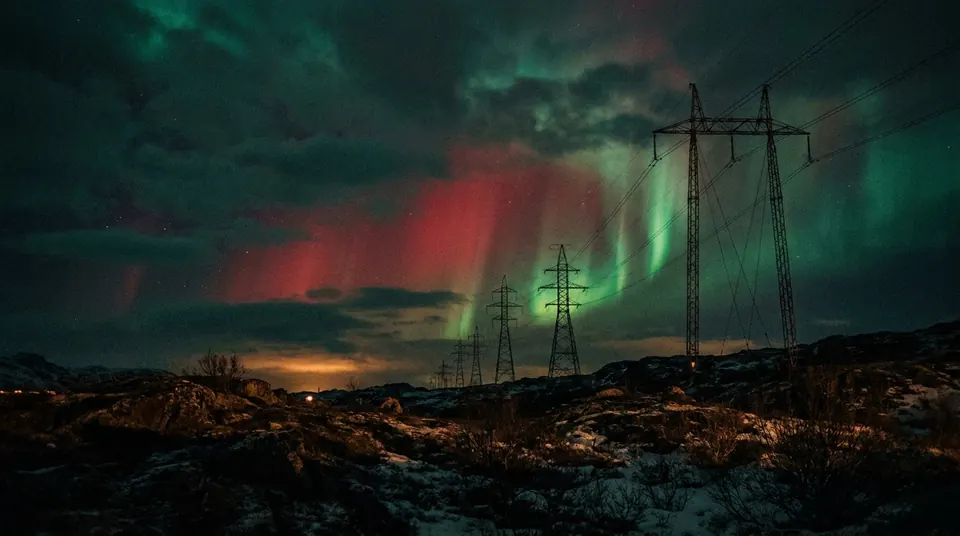
A repeat of the 1859 Carrington event would induce large currents in long power lines and could damage high-voltage transformers, causing regional blackouts. Lloyd’s estimated $0.6 to $2.6 trillion in losses. Estimates of the odds range from under 1% to about 12% per decade.
Key findings
- The 1859 storm sparked telegraph lines and lit auroras as far south as Cuba. Its measured strength (Dst) was roughly -900 nT.
- A comparable CME missed Earth by about one week in July 2012. Modeling put it near -1,200 nT.
- Quebec’s grid collapsed in under 90 seconds in March 1989; about 6 million people lost power for about nine hours.
- Lloyd’s 2013: $0.6 to $2.6 trillion in losses and 20 to 40 million US people in extended outages, from several weeks to one to two years.
- Probability estimates for the next decade range from about 0.5% to about 12%, depending on method.
MythA solar flare would wipe out all electronics worldwide.
EvidenceSolar storms act mainly through induced currents in long conductors such as power lines. Small unplugged electronics are not the main target, and the May 2024 G5 storm did not cause a major US grid failure that we could find.
MythWe would get no warning.
EvidenceNOAA says the fastest Earth-directed CMEs take about 15 to 18 hours to arrive, slower ones several days, and a satellite at L1 sees the shock 15 to 60 minutes before it hits.
The Carrington event is the strongest solar storm in the modern record, and it hit in the age of the telegraph. In early September 1859, NASA notes, auroras reached as far south as Cuba, and telegraph lines sparked, setting some offices on fire. The question is what the same storm would do to a world built on high-voltage grids.
The short answer: the grid is the target, not your phone. Long power lines act as giant antennas for the storm’s slowly changing magnetic field, and the currents they pick up can overheat large transformers. Estimates of the damage and the odds vary widely, and this article gives the ranges and where they come from.
What happened in 1859
An English astronomer, Richard Carrington, observed the flare on the Sun that started it. In the following days a series of powerful coronal mass ejections (CMEs) hit Earth head-on, with what NASA describes as “a potency not felt before or since.” The telegraph network, then the most advanced technology on Earth, was the instrument that recorded the effect. The sparks and fires NASA describes were the visible sign of induced current in long wires.
The scale: the USGS puts the Carrington storm at about -900 nT on the Dst index, which measures the drop in Earth’s magnetic field during a storm. For comparison, the March 1989 storm reached -589 nT and the May 2024 storm reached -351 nT. Dst and NOAA’s G-scale rate different things, so the comparison is approximate, but the order is clear.
Flare, CME and geomagnetic storm: what causes the damage
These get mixed up, so here is the sequence.
- A solar flare is a burst of electromagnetic energy. It reaches Earth in about eight minutes and mostly disturbs radio and navigation signals on the sunlit side.
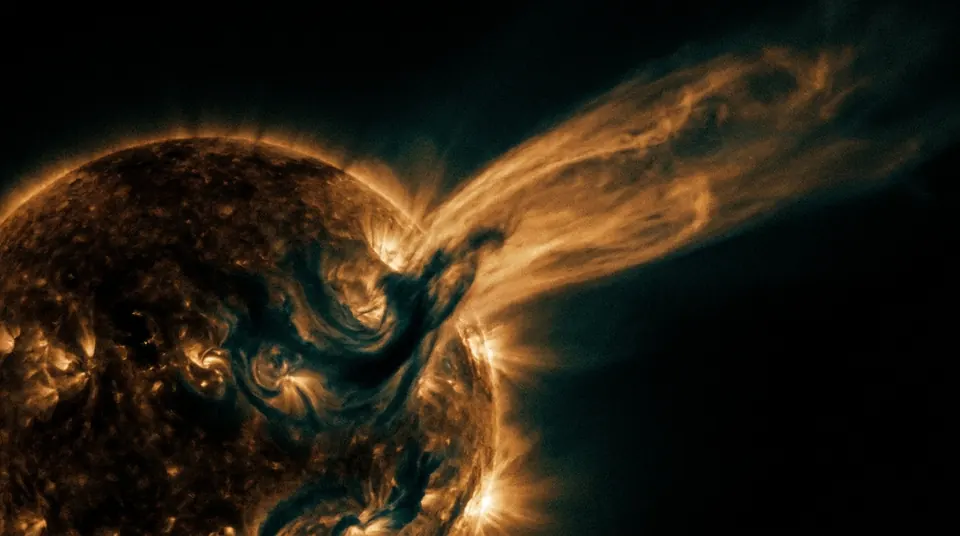
- A coronal mass ejection is a cloud of plasma and magnetic field thrown off the Sun. Per NOAA, CME speeds run from under 250 km/s to nearly 3,000 km/s. The fastest Earth-directed ones arrive in roughly 15 to 18 hours, slower ones in days.
- A geomagnetic storm happens when the CME arrives and its magnetic field connects with Earth’s. Storms are stronger when the CME’s field points south and stays that way for a long time.
The power-grid problem comes from the third step. A rapidly changing magnetic field induces an electric field in the ground. Long transmission lines grounded at both ends then carry a slow, nearly DC current. These are called geomagnetically induced currents, or GICs. Transformers are built for 60 Hz alternating current. Slow GIC pushes the core into saturation, which causes overheating, harmonics and possible damage to the transformer and tripping of protective gear.
Geology matters. Hydro-Québec points to its long lines and the resistive rock of the Canadian Shield as reasons its grid is especially exposed.
Four storms that tell you what to expect
March 13, 1989: Quebec
A storm that reached about -589 nT collapsed the James Bay network in less than 90 seconds. About six million people lost power. Most service returned in about nine hours, though some customers waited longer. A transformer at a nuclear plant in Salem, New Jersey, was severely damaged the same night. According to an archived Canadian government page, a spare was on hand, so replacement took about six weeks instead of the usual year or so, and replacement power cost roughly $17 million, more than the transformer.
October 2003: the Halloween storms
The last G5 storm before 2024. USGS notes it caused blackouts in Sweden and South Africa. Transformer damage was reported in South Africa.
July 23, 2012: the near miss
A CME at least as strong as the 1859 one passed through Earth’s orbit but missed the planet and hit the STEREO-A spacecraft. Physicist Daniel Baker said that if the eruption had happened a week earlier, Earth would have been in the line of fire. Baker and colleagues estimated that it would have produced a Dst of about -1,200 nT, comparable to or stronger than 1859. The CME’s speed was estimated near 3,000 km/s, about four times a typical CME.
That event matters for one reason. It shows that Carrington-class eruptions are not once-in-a-millennium accidents of 19th-century astronomy. One happened in the era of space satellites, and we watched it.
May 10 to 11, 2024: G5
NOAA rated it G5, the highest level and the first since October 2003. Per USGS, the disturbance began at 12:06 Eastern on May 10, and the Dst minimum was -351 nT. Auroras were visible far south of normal. A 2025 study of GIC observations analyzed the effects on US grids. We did not find a report of a major US grid failure. NOAA did note, in the aftermath, that a power blackout could occur with future storms. The storm was far weaker than 1859 or 1989 on the Dst measure, so it is not a test of the worst case.
What a Carrington event would do today
Nobody has seen one, so these are models. Treat the numbers as informed estimates with wide error bars.
Lloyd’s of London and Atmospheric and Environmental Research (2013). Lloyd’s report modeled a Carrington-level storm on North America. According to Insurance Journal’s coverage, it estimated losses of $0.6 trillion to $2.6 trillion, with 20 million to 40 million people in the United States facing power cuts lasting from several weeks to one to two years. It flagged the East Coast as high risk, along with the Midwest and Gulf Coast. Lloyd’s gave a return period of about 50 years for a Quebec-level storm and about 150 years for a Carrington-level one.
National Academies. NASA cites a National Academy of Sciences study that said total economic impact could exceed $2 trillion, about 20 times the cost of Hurricane Katrina.
These two land in the same range, but they are models, not observations. More optimistic views argue that operators now know how to respond: reduce load, switch lines, bring on extra generation and keep the system out of its worst states. NERC has also issued reliability standards on geomagnetic disturbances, as the PJM fact sheet discusses, and operators now get space-weather warnings.
What nobody can say with confidence is how many large transformers would fail. A few, as in 1989, means a regional blackout and weeks of recovery. Many means a long outage, because large transformers are custom-built. A GAO review found utilities rank supply constraints and manufacturing lead times as their biggest problem, and Wood Mackenzie data put waits for large units at roughly 80 to 210 weeks (about 1.5 to 4 years). DOE’s 2014 study put waits in 2010 at 5 to 16 months, so recovery would be slower than older planning figures assumed.
How likely is it?
Estimates for the chance of a Carrington-sized storm in the next decade differ by more than an order of magnitude:
| Study | Estimate for next decade |
|---|---|
| Riley (2012, Space Weather) | About 12% |
| Riley and Love (2017) | 10.3%, 95% interval roughly 0.9% to 18.7% (power-law model) |
| Kataoka (2013) | About 4 to 6% |
| Moriña et al. (2019) | About 0.5 to 1.9% |
Lloyd’s 150-year return period for a Carrington-level storm implies roughly 6 to 7% per decade, by our arithmetic. The figures for studies other than Riley (2012) come from secondary summaries of the papers, so verify them before quoting. Another estimate in the literature, from Chapman and colleagues in 2020, is 0.7% per year. That would be about 7% per decade if the events were independent, which is our arithmetic and not their statement.
Why the spread? There is one Carrington event in the instrumental record, so these are extrapolations from a handful of data points. Riley himself noted that the answer depends heavily on how an extreme event is defined. The USGS has published work specifically on the uncertainties in these forecasts.
A fair reading: it is a low-probability event per decade, with a real tail. Odds from under 1% to roughly 12% per decade, with the honest answer being “somewhere in there, and nobody knows.”
What warning would we get?
More than people think, but less than we would like.
- Space weather forecasters watch the Sun continuously. A flare is a sign that a CME may follow. NOAA says the fastest Earth-directed CMEs arrive in about 15 to 18 hours.
- Once a CME is on its way, the DSCOVR satellite at L1 sees the shock about 15 to 60 minutes before arrival. That gives the sharpest measurement of the storm’s magnetic orientation, which determines how strong it will be.
- Grid operators can use that window to reduce load on key lines, bring more generation online and put sensitive equipment on alert. In May 2024, NOAA issued a G4 watch on May 9, ahead of the storm.
The warning does not stop the storm. It improves how the grid responds. Our guide to solar storm alerts explains the watch, warning and alert messages and the G scale. Whether that is enough for a 1859-class event is the unresolved question.
What to do about it
You cannot prevent a solar storm, and you cannot protect the grid yourself. What you can do is prepare for the consequence, which is a long blackout. Our grid-down timeline gives the hour-by-hour sequence and what to do at each stage.
A solar storm is not an EMP. It does not produce the fast E1 pulse that threatens small electronics, and its effect is on long conductors. What an EMP does explains the difference, and the E3 part of a nuclear EMP is physically similar to a geomagnetic storm.
Short list:
- Store water: one gallon (about 4 liters) per person per day.
- Have a heat or cooling plan that does not need the grid.
- Keep a battery radio for official information.
- Hold a month of any critical prescription, if your doctor agrees.
- Build up from three days to two weeks over time, as budget allows.
The survival gear guide covers what is worth buying.
Note: If a G4 or G5 watch is issued, it does not mean a blackout is coming. It means the grid may be stressed. In May 2024 no major US grid failure that we could find followed a G5 watch.
Lab verdict
The Carrington event is a real risk with an uncertain size. Physically, it works through induced currents in long lines and transformers, not through your gadgets. Models give a wide loss range, $0.6 to $2.6 trillion, and outage durations from weeks to a year or two. Per-decade odds range from under 1% to about 12%, depending on the method.
The measures that help are the same as for any long blackout. Prepare for weeks, not for the apocalypse.
Frequently asked questions
What was the Carrington event?
A series of powerful solar eruptions in early September 1859 caused the strongest geomagnetic storm in the modern record. Auroras reached the tropics, and telegraph lines sparked, in some cases starting fires. It is named for Richard Carrington, who saw the associated flare.
What would happen if a Carrington event happened today?
Long power lines would carry induced currents that could overheat and damage large transformers. Lloyd’s modeled $0.6 to $2.6 trillion in losses and 20 to 40 million US people without power for weeks to one to two years in the worst case. Estimates vary, and grid operators now get warnings.
How likely is another Carrington event?
Published estimates for the next decade range from about 0.5% to about 12%, depending on the statistical method and how the event is defined. The wide range reflects only one such storm in the instrumental record. No one can say precisely.
Would phones and electronics be destroyed by a solar storm?
Not directly. The main effect is on long conductors, such as power lines. Small unplugged electronics are not the target. Satellites, GPS and radio can be disrupted, and if the grid goes down, most devices stop working anyway once their batteries run out.
How much warning would we have?
NOAA says the fastest Earth-directed CMEs arrive in about 15 to 18 hours, and slower ones take days. A satellite at L1 can detect the shock 15 to 60 minutes before it hits. That is enough for grid operators to take protective steps.
Sources
- NASA: A Super Solar Flare (July 2012 near miss and 1859 event)
- NOAA SWPC: Coronal mass ejections
- USGS: May 10, 2024 magnetic disturbance
- Hydro-Québec: The March 1989 solar storm blackout
- PJM: Geomagnetic disturbances fact sheet
- Natural Resources Canada, archived: Space weather and power systems
- Lloyd’s: Solar storm risk to the North American electric grid (2013)
- Insurance Journal: Solar storm threats pose emerging risk for industry, Lloyd’s
- Riley (2012), On the probability of occurrence of extreme space weather events, Space Weather
- USGS: Extreme geomagnetic storms, probabilistic forecasts and their uncertainties
- Wilkerson et al. (2025): GIC observations during the May 2024 storm (arXiv)
- GAO-23-106180: Electricity grid transformer supply chain
General information, not medical or professional advice. In a real emergency, follow instructions from officials and call 911. Disclaimer.