File 012 GRY // Gray Man & OPSEC
Can You Hide From Thermal Imaging? What Physics Actually Blocks
Glass and walls block thermal cameras, but mylar, mud and cloth mostly fail. See what long-wave infrared does, and why lost people should stay visible.
Lab verdict
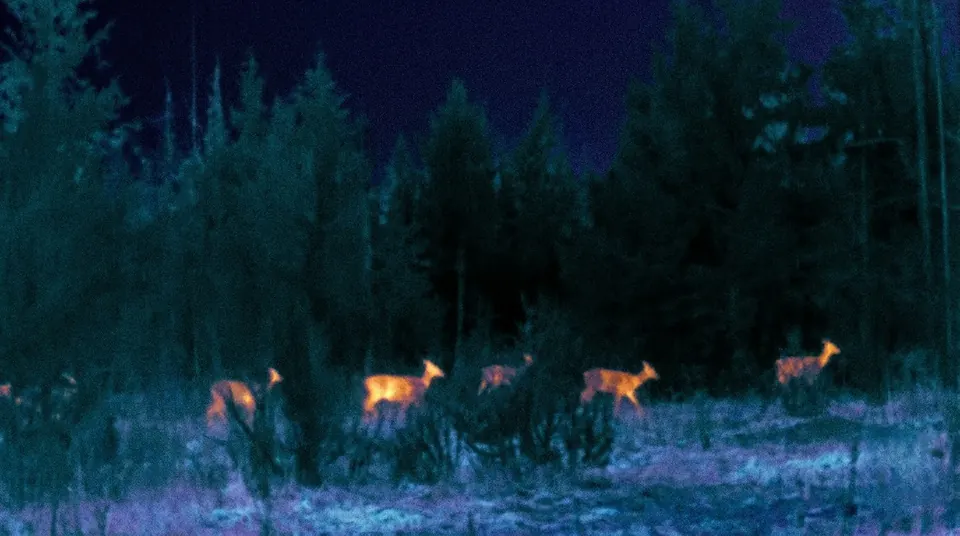
Partly, and not for long. Thermal cameras read long-wave infrared from surfaces. Glass and solid walls block it, but they show their own surface heat. Foil blankets hide a body shape yet look like odd cold patches, and covers warm up toward your temperature over time.
Key findings
- Thermal cameras see surface temperature, not through walls or glass. Ordinary glass is opaque to long-wave infrared and acts like a mirror.
- Foil blankets have very low emissivity and reflect their surroundings, so they can hide a body shape but create a conspicuous cold or bright patch.
- Mud, wet cloth and thin fabric have high emissivity, so they show their own temperature, and they warm as your heat flows into them.
- Thermal drones are widely used in search and rescue. If you are lost, make yourself easy to see.
MythA space blanket makes you invisible to thermal cameras.
EvidenceA 2020 study found a rescue blanket can hide body shape, but unusually cold readings and steep temperature gradients can still draw attention, and the authors recommend removing the blanket from the body for thermal searches.
MythThermal cameras see through walls.
EvidenceFLIR says walls are thick and insulated enough to block infrared from the other side. The camera shows the wall’s own surface heat.
MythA layer of mud hides your heat.
EvidenceMud has high emissivity, so it shows its own temperature, and it warms as your body heat conducts through it. Any cover that insulates only delays that.
Can you hide from thermal imaging? In a narrow sense, yes. A thermal camera cannot see through glass, solid walls or a thick sheet of plastic. In the way people usually mean it, wrapped in a foil blanket or covered in mud, mostly no.
The reason is physics, not technology. A thermal camera does not see heat as such. It reads infrared radiation that every warm surface emits, so it reports what a surface is doing, not what is behind it. Hiding means controlling that surface, and a warm body keeps feeding heat into whatever you put over it.
This is a myth-busting guide to the mechanism. It also covers the part many “hide from drones” videos skip: thermal drones are widely used in search and rescue, so if you are lost, the goal is the opposite of hiding. Our gray man strategy guide covers the human side of staying unnoticed. Here it is just optics and heat.
How thermal cameras actually see
Everything warmer than absolute zero emits infrared radiation. Most thermal cameras work in the long-wave infrared (LWIR) band, about 8 to 14 micrometers, which is a window where air passes this radiation well (Inspect & Test guide). A body near 33°C (306 K) peaks at about 9.5 micrometers by Wien’s law (our calculation), which sits in that band.
The camera collects that radiation from the first surface it hits and turns it into a picture. Three things set what that picture shows:
- Surface temperature. Warmer surfaces emit more.
- Emissivity. How efficiently a surface emits and absorbs LWIR, on a scale of 0 to 1. High-emissivity surfaces show their true temperature. Low-emissivity surfaces mostly reflect their surroundings.
- Reflection. A shiny surface shows a thermal image of whatever it faces.
Two practical results follow. A thermal camera cannot measure something behind a surface that is opaque to LWIR. And a reflective surface is not invisible. It shows something else.
What blocks LWIR and what doesn’t
Teledyne FLIR is direct on the basics. Walls are generally thick and insulated enough to block infrared from the other side, so the camera sees the wall’s surface. Glass is opaque to infrared, and for these cameras “acts like a mirror,” which is why a camera pointed at a window shows a reflection of the operator. Very thin plastic, like a garbage bag, can pass infrared, but thicker plastic blocks it (FLIR).
Here is how common materials compare. “How long it works” is our physical reasoning, labelled as an estimate, not a measured result.
| Material | Blocks LWIR? | How long it works | Notes |
|---|---|---|---|
| Ordinary window glass | Yes, opaque and reflective | While you stay behind it | Glass itself warms and radiates; you may see its surface or a reflection. |
| Solid wall | Yes | Always, for the far side | The wall’s own surface heat shows. Leaks and warm spots can appear. |
| Thin plastic bag | No, mostly passes | Never | Visible light blocked, infrared passes. |
| Thick plastic sheet | Mostly yes | Until the surface warms | The outer surface warms from your heat. |
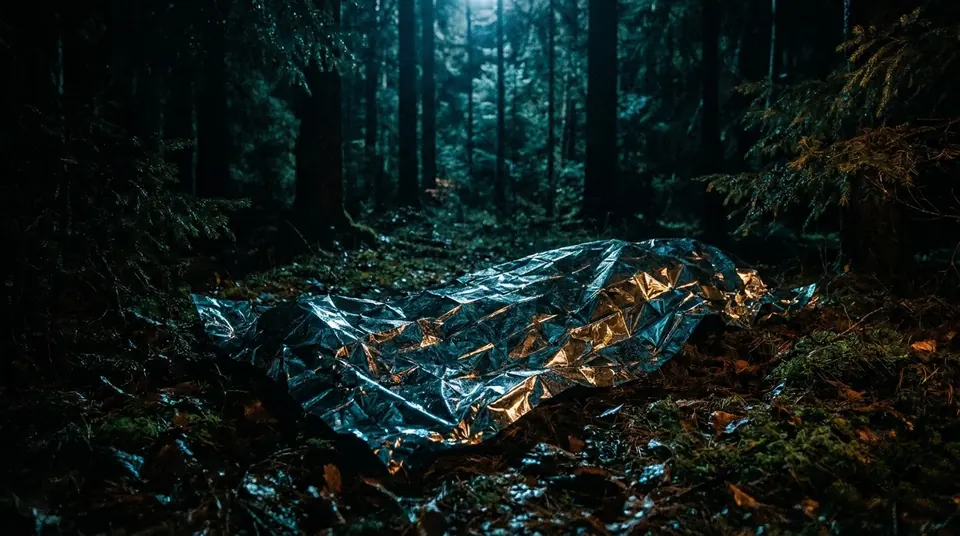
| Foil or mylar blanket | Blocks transmission, reflects | Short and unreliable | Low emissivity, shows reflected surroundings, creates odd patches. |
| Mud | No, high emissivity | Minutes, estimate | Shows its own temperature, warms from contact. |
| Cloth or clothing | Partly insulates | Depends on thickness | The outer surface still warms. |
| Leaves and foliage | Partly | Varies | Gaps and multi-angle imaging reveal people. |
Does glass block thermal imaging?
For long-wave thermal cameras, yes. Ordinary glass is opaque to LWIR and acts like a mirror. A person standing behind a closed window is not seen through the glass. The camera sees the window surface and any reflection on it.
Two caveats keep this from being a hiding technique.
First, glass is a surface too. It warms from the room. A warm window pane against a cold exterior shows up as a bright rectangle, which tells an operator something is inside. Second, shorter infrared wavelengths, below about 4 micrometers, pass partly through glass, which is why some special cameras can see through it. Those are a different type of sensor from the LWIR cameras on most drones.
Does a space blanket block thermal?
This is the claim most of the “$20 trick” videos rest on. The physics supports half of it.
Aluminized mylar has very low emissivity. Reference tables put aluminum foil in the range of about 0.03 to 0.09 (emissivity table, Engineering ToolBox). Low emissivity means it emits little of its own heat and reflects whatever surrounds it. In the open at night, that means the sky.
A 2020 study in SN Applied Sciences tested rescue blankets against drone-style thermal imaging. According to the published abstract and summaries, a single layer was enough to make a body shape unrecognizable and three layers nearly blocked infrared. But the authors note that rescue blankets can make a person easier to spot, because of steep temperature gradients at the edges, and that unusually cool readings from 1 to 2 meter objects in cold conditions may be reflections from a blanket. They recommend removing the blanket from the body to improve the chance of being found by a thermal search (study listing on DOAJ). We only had access to the abstract and summaries, not the full paper.
So a foil blanket can hide a human shape. It does not make a scene look empty. An operator sees a strange object, and in a search that is a reason to look closer.
Myth: “Wrap in mylar and the drone sees nothing.” What it often sees is a cold, shiny, human-sized anomaly.
Why mud, cloth and cover fail over time
Body heat does not stay inside. It conducts outward through anything touching you, and the outer surface rises toward your temperature until it loses heat to the air as fast as it receives it.
How fast depends on thickness, material, wind and air temperature. We found no measured timings for mud or cloth against thermal cameras, so any figure would be a guess. The direction is clear:
- Mud has high emissivity, so it shows its own temperature. A wet, thin layer warms quickly and shows you.
- A thick, dry, insulating layer such as a pile of dry leaves, can delay the warm-up, but the surface still warms as heat builds.
- Heat from your breath, hands and face still radiates from any gaps.
Temperature contrast matters too. Thermal pictures are easier to read when your surface differs from the background. In general thermography practice, a person stands out most against a colder background, such as at night or in snow. Warm sun-heated rock, pavement and rooftops can give false hot spots, which is part of why operators sometimes struggle in daytime. That is general practice, not a test we ran.
What about foliage?
Leaves block LWIR partly, not fully. Researchers have shown that a drone that merges many thermal frames from different viewpoints can see through forest canopy. A Science Robotics system based on airborne optical sectioning found hidden people in about 90 percent of 17 field trials, and 38 of 42 people in free flight, though each flight was limited to 15 to 20 minutes by battery life (AAAS summary). Dense cover reduces detection, but it does not remove it.
Thermal drones are mostly a rescue tool
Thermal imaging is widely used by search and rescue teams and public safety agencies to find lost and injured people, often at night. News reports describe a missing hiker found in the Vienna Woods within 75 minutes of the first call (DroneXL), and thermal drones helping locate a woman lost for more than nine hours in Mississippi woods in February 2026 (WLOX). These are individual news reports, not a success-rate dataset.
If you are lost or injured, you want that camera to find you. This is where the physics above flips:
- Stay in the open if you can do so safely. Clearings, ridgelines and open ground give the camera a clear line of sight.
- Do not wrap a foil blanket around your body during a search. Keep it off your body as the study recommends, and use it as a visual signal: lay it flat in the open or hold it up in sunlight. The same study notes it flashes in sun.
- Lie still on open ground and keep your body visible rather than burrowing into undergrowth.
- Use other signals too. Bright clothing, a light and a whistle help ground teams, and thermal helps from above. If you have a phone signal, call emergency services first.
- Stay warm. Hypothermia can end the search badly. See how long you can survive in the cold for how heat loss works.
Note: This article describes physics and rescue practice. It is not a guide to evading law enforcement.
Myths we checked
“Thermal sees through walls”
It does not. A thermal camera shows the heat of the wall’s surface. Studs, pipes, missing insulation and leaks can show up because they change that surface temperature, which is how inspectors use them. A person standing behind a normal wall is not visible.
“Glass hides you”
Only in the narrow sense that the camera cannot see through it. The glass itself is a warm surface, and an open window or a pane warmed by the room can mark where heat is.
“A $20 trick works forever”
No cover is permanent. Reflective covers show reflections. Insulating covers warm. Only a barrier that is itself held at ambient temperature against the background would help, and that is not something a thin blanket does.
Lab verdict
The honest answer is “partly, briefly, and with trade-offs.” Glass and solid walls stop LWIR. Foil hides a shape but makes an anomaly. Mud and cloth show their own surface heat as they warm. Dense foliage helps, but multi-angle imaging has been shown to defeat it in research trials.
For lost-person situations, the lesson is simple. Do not hide from the camera that is looking for you. Put your blanket on the ground as a signal, keep your body warm and visible, and plan your kit with our survival gear guide.
Frequently asked questions
Does glass block thermal imaging?
Yes, for the long-wave thermal cameras most drones carry. Ordinary glass is opaque to long-wave infrared and acts like a mirror, so the camera shows the glass surface or a reflection, not what is behind it. Some shorter-wavelength infrared cameras can partly see through glass, but those are a different sensor type.
Does a space blanket block thermal imaging?
It can hide a body shape. A 2020 study found one layer made a body unrecognizable. But foil reflects its surroundings, can read as an odd cold patch, and creates sharp temperature edges. The authors recommend removing the blanket from your body when you want a thermal search to find you.
Can thermal cameras see through walls?
No. FLIR says walls are thick and insulated enough to block infrared from the other side. Thermal cameras show wall surface temperature. They can reveal pipes, leaks or insulation gaps that change the surface, but not people behind the wall.
Can thermal imaging see through trees?
Partly. Foliage blocks some infrared, but research drones that combine many thermal images from different angles have found hidden people in roughly 86 to 90 percent of field tests. Dense canopy lowers the odds without removing them.
What should I do if a thermal drone is searching for me?
Make yourself visible. Move to open ground if it is safe, stay with your gear, wave or signal, and keep any foil blanket off your body so your heat can show. Call emergency services if you have signal. Search teams use thermal drones to find people.
Sources
- Teledyne FLIR: Can Thermal Imaging See Through Walls?
- Engineering ToolBox: Emissivity coefficients
- Inspect & Test: How thermal imaging works
- DOAJ: Rescue blankets hamper thermal imaging in search and rescue missions (SN Applied Sciences, 2020)
- AAAS: Rescue drone sees through thick forest to track people (Science Robotics)
- DroneXL: Vienna police drone finds missing hiker
- WLOX: Thermal drones help rescue woman lost in Mississippi woods
General information, not medical or professional advice. In a real emergency, follow instructions from officials and call 911. Disclaimer.