File 002 NUC // Nuclear & Radiation
Nuclear Fallout Shelter in an Apartment: Where to Go and How to Improve It
No basement? Learn how a nuclear fallout shelter in an apartment works: protection factors, the best floor and room, how to add mass, and when to move.

Lab verdict
In an apartment, go to an interior room on a middle floor of a large concrete or brick building, away from windows, outside walls and the roof. FEMA’s building diagram shows middle floors of big buildings cutting fallout dose roughly 20 to 50 times. Stay at least 24 hours, and add dense mass between you and the outside.
Key findings
- Protection factor (PF) is how many times a place cuts your dose. FEMA calls 10 or more adequate shelter.
- Large concrete or brick buildings are best. FEMA’s diagram shows middle-floor interior spots at roughly 20 to 50, and top and ground floors lower.
- The roof is the weak point. Fallout piles up there, so the top floor scores about 10 in FEMA’s diagram.
- Fallout is dust, not gas. You do not need to seal windows with tape; you need mass and distance.
- Only move to a better shelter if it is close and you act early. FEMA’s planning rule is within about 30 minutes for a PF 2 building.
MythTaping plastic over every window and door makes an apartment safe from fallout.
EvidenceFEMA says structures do not need to be airtight to protect against fallout radiation. The hazard is gamma rays from dust outside, which plastic does not stop. Mass and distance do.
MythThe higher up you go, the safer you are.
EvidenceHeight helps until the roof. Fallout collects on roofs, so FEMA’s diagram scores top floors around 10, while middle-floor interior spots of big buildings score 20 to 50 or more.
Most people do not live above a basement. If you rent a flat in a mid-rise or a tower, you still have a decent shelter option, because a nuclear fallout shelter in an apartment is mostly about where in the building you stand, not what you buy. The rest is arithmetic: mass and distance.
This guide explains protection factor, shows what FEMA’s building diagram says about different floors, and gives a step-by-step plan for an ordinary apartment. It builds on the timeline in how to survive a nuclear attack. Read that first if you want the flash, blast and first-hour steps.
What a protection factor means
Fallout radiation that matters in the first day is mostly gamma rays from particles on the ground and roofs. Gamma rays are not blocked, they are weakened. Every layer of concrete, brick, earth or water they pass through reduces them, and so does every extra yard of distance.
The reduction is expressed as a protection factor, or PF. FEMA’s Planning Guidance for Response to a Nuclear Detonation defines it this way: a PF of 10 means you receive one tenth of the dose of a person in the open. A PF of 200 means one two-hundredth.
FEMA calls a shelter adequate if it reduces dose by a factor of 10 or more. Its examples are basements, the centers of large multi-story structures, parking garages and tunnels. It says cars and single-story wood-frame houses without basements are not adequate shelter.
Here is what that means in numbers. Take the same arbitrary starting point FEMA uses in its fallout decay figure: 100 roentgen per hour at one hour after detonation. Our own arithmetic, using the standard decay approximation (dose rate falls with time to the power of -1.2), says a person standing outdoors from hour 1 to hour 49 would collect roughly 270 R. This is an illustration, not a prediction, since real fallout varies enormously with weather and distance. In a PF 3 spot that same period would be about 90 R. In a PF 30 spot, about 9 R. For context, REMM notes that a whole-body dose of 200 cGy or more may need urgent evaluation for acute radiation syndrome. See the fallout decay explainer for the model and its limits.
The point is that the difference between a PF of 3 and a PF of 30 is the difference between a bad outcome and an uneventful one.
What FEMA’s building diagram shows
FEMA’s planning guide includes a color-coded illustration of building types and their protection factors. We pulled the numbers from the figure itself. They are approximate and building design changes them, so treat them as typical values, not guarantees.
| Building | Where you are | Approximate PF (FEMA figure) |
|---|---|---|
| 1-story wood frame | Main floor | 2 to 3 |
| 1-story wood frame | Basement | about 10 |
| 2-story brick veneer | Upper floor | about 3 |
| 2-story brick veneer | Basement | about 20 |
| 3-story brick or concrete | Upper floors | about 7 to 20 |
| 3-story brick or concrete | Basement | about 50 |
| 5-story brick or concrete | Top floor | about 10 |
| 5-story brick or concrete | Middle floor interior | about 20 |
| 5-story brick or concrete | Basement and sub-basement | 100 to 200 |
| Large office or apartment tower | Top floor | about 10 |
| Large office or apartment tower | Most middle-floor spots | about 20 to 50, a few near 100 |
| Large office or apartment tower | Ground-level row | about 10 to 20 |
| Large office or apartment tower | Below ground, parking | about 20 to 200 |
Two patterns stand out.
Mass wins. Brick and concrete beat wood and drywall. FEMA lists concrete, brick, stone and earth as good shielding and wood, drywall and thin sheet metal as minimal. Many layers of minimal material can still add up: central rooms with many intervening drywall walls can reach adequate protection.
Distance from the dust matters. The roof collects fallout. The ground collects it too. The middle of a tall building has floors above and below to absorb radiation, and the farthest horizontal distance from outside walls. That is why FEMA says middle floors generally shield better than ground floors or exterior locations, with the roof as the exception.
Lawrence Livermore National Laboratory researchers modeled more than 10,000 buildings to work out which ones protect people best. They report that nonresidential buildings such as offices, churches, supermarkets and schools often protect better than surrounding housing, and that building size, wall and floor mass, basements and openings drive the result (see their Sheltering Science Saves Lives article). In practice, a big concrete office block next door can beat your own wood-frame walk-up.
Your nuclear fallout shelter in an apartment: a decision list
Work through these in order.
- Is your building a large concrete or brick structure? If yes, you are probably in an adequate shelter already. If it is a wood-frame walk-up of three or four floors, your PF is closer to 3 to 10. Look for something better (step 5).
- Which floor? Go to the middle third of the building. Avoid the top floor because of roof fallout. Avoid being right at ground level on the street side.
- Which part of the floor? Go to an interior room or hallway with no outside wall, such as a bathroom or inner corridor. FEMA’s guidance is to be away from windows, corners, doors and outside walls. A stairwell core in a concrete building is often thick and central, but check that it is not glass-walled.
- Can you go down? If the building has a basement, parking garage or an underground level that is safe and open, FEMA’s figures put it at 100 to 200 in a big building. Go there if you can reach it within the 10 minutes or more Ready.gov says you will have before fallout arrives. Do not use an elevator if there is power failure risk.
- Is there a clearly better building within a few minutes’ walk? Only then consider moving. See the section below.
You should make these choices before an emergency. Walk your building now: count floors, find the interior rooms and look for a basement or garage.
Improve your spot
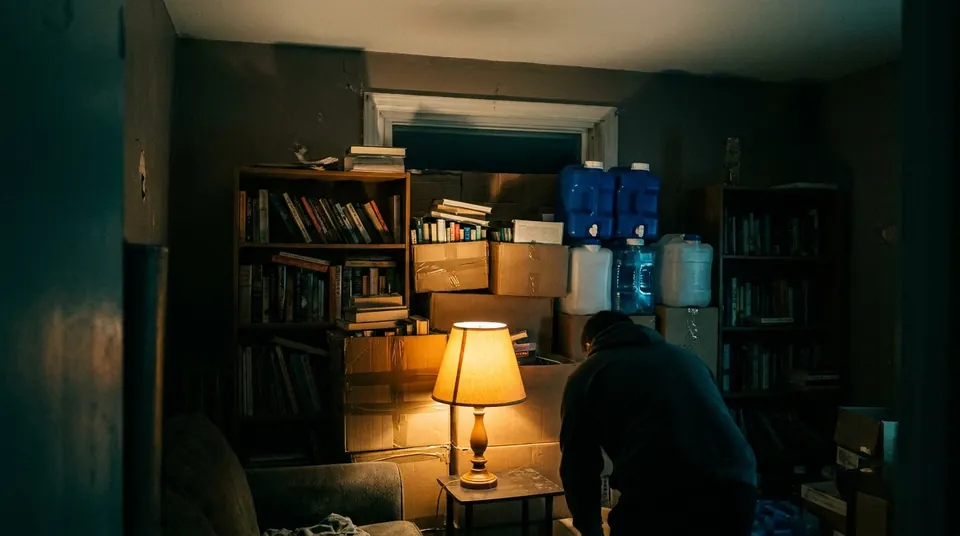
Once you are in the best position the building gives you, add mass. The principle comes from the same FEMA shielding list: dense material between you and the outside.
- Water. Filled containers are dense and you need them anyway. Ready.gov’s emergency kit guidance is one gallon per person per day for several days. Stack them between you and the nearest outside wall.
- Books and files. Full bookcases and filing cabinets are heavy. Place them on the side facing outside walls, and on the floor above if you are under a roof.
- Furniture and mattresses. Dense furniture adds some mass, but mattresses are mostly air and add little. This is our reading of the shielding principle; FEMA does not rank furniture.
- Appliances. A full washing machine or fridge is a lot of mass.
How much does this add? We do not have a tested number for a typical apartment, and we do not want to invent one. Mass helps, and more mass helps more, but a bookcase is not a concrete wall. The better lever is picking a good location in the first place.
What not to waste time on
Myth: “Seal the windows with plastic and duct tape.”
Ready.gov’s general emergency kit list includes plastic sheeting and duct tape for sheltering in place. For fallout specifically, FEMA says structures do not need to be airtight. Fallout is particles, not gas, and the radiation passes through plastic regardless. A few minutes spent on tape is time not spent getting to the right room.
What Ready.gov does advise for a nuclear explosion is to shut off fans, air conditioners and forced-air heating that pull in outside air, and to close windows, doors and fireplace dampers.
What to have in the room
You may be there at least 24 hours. Ready.gov says sheltering usually lasts at least 24 hours, and FEMA says the optimal stay can run from a few hours to several days depending on dose rates.
- A radio that runs on batteries or a hand crank. Ready.gov’s kit page lists a battery-powered or hand-crank radio. FEMA says AM/FM is best for updates.
- Water. One gallon per person per day.
- Food that needs no cooking. Food kept indoors is safe, per Ready.gov.
- Flashlight, spare batteries, phone charger and backup battery.
- First aid kit and any medications.
- Sanitation: garbage bags, plastic ties, moist towelettes and a bucket with a lid. Plumbing may fail.
- A change of clothes and a bag for contaminated clothing, as Ready.gov suggests.
- A dust mask or cloth for the nose and mouth. FEMA says a cloth mask is a crude but reasonable extra measure. See what a gas mask for nuclear fallout adds.
Medicine counts. If you take a daily prescription, keep a supply. Do not take iodine pills on a guess: potassium iodide is only for use when officials tell you to, and it protects the thyroid from radioactive iodine, not the rest of the body.
Pets
Ready.gov says to bring pets and service animals inside if told to stay in. Brush any dust from their coats gently when they come in, then wash with soap and water if you have it. Keep food and water inside for them too.
When to leave your shelter, and when not to
The tempting move is to flee to a better building. FEMA’s guidance is more specific than most people expect.
For a poor shelter (PF about 2) with an adequate shelter within about 15 minutes of travel, FEMA says to stay no longer than 30 minutes after the detonation before moving. For a better but still limited shelter (PF about 4), stay one to two hours. These rules are written for planners and assume you know where the better shelter is and that the route is open. They do not apply if the better shelter is far.
If you are already in an adequate shelter, stay. FEMA says uninjured people with adequate shelter and safe food and water are a low priority for early evacuation. Moving through the early dose-rate peak costs more than it saves.
Always leave if the building is on fire or unstable. FEMA states that even inside the dangerous radiation zone, people should leave a burning building.
After 24 hours, follow official instructions on when and which way to go. FEMA says evacuations should occur only after safe routes are identified, and often lateral (at right angles to the fallout path). Do not return home until local authorities say it is safe, as Ready.gov states.
What changes if you live near the blast
Everything above applies to places outside the severe damage zone. For a 10 kiloton ground burst, FEMA puts that zone at about half a mile, the moderate damage zone at about half a mile to one mile and the light damage zone at about 1 to 3 miles. Light damage mostly means broken windows, which is why the advice to stay away from glass matters. The main guide has the full table.
In the moderate damage zone, lighter commercial and residential buildings may become structurally unstable, and most wood-frame houses are destroyed. Sturdier reinforced concrete buildings stay up. If your apartment is concrete, your odds are better. If it is wood frame in that zone, you are in a much worse position, and getting to a sturdier building after the blast wave passes may be the best option.
Frequently asked questions
What is the best floor to shelter on in a high-rise?
The middle. FEMA’s diagram shows most middle-floor spots in a large building at roughly 20 to 50, with the top floor at about 10 because of fallout on the roof. FEMA also says middle floors generally shield better than ground floors or exterior locations. Pick an interior room, away from windows. We apply this to a tower-heavy city in our look at what would happen if a nuke hit New York.
Is a basement better than an apartment?
Usually. Below-grade spaces get earth on several sides. FEMA’s diagram shows about 10 for a wood-frame house basement, about 20 under brick veneer and 100 to 200 for basements of large brick or concrete buildings. A middle-floor interior of a big concrete tower can match a house basement. If you have a basement, see how to build a fallout shelter in a basement.
Do I need to seal my apartment against fallout?
No. FEMA says shelters do not need to be airtight. The hazard is gamma radiation from particles outside. Ready.gov does advise turning off fans, air conditioners and forced-air heating that bring in outside air, and closing windows and doors. That keeps dust out but is secondary to location.
Can I shelter in a wood-frame apartment building?
You can, but protection is lower. FEMA lists single-story wood-frame houses without basements as not adequate, with typical PF around 2 to 3. Interior rooms with many walls add some shielding. If a concrete building or basement is nearby, FEMA’s early-move rule is within about 30 minutes for a PF 2 building.
How long do I stay in my apartment shelter?
At least 24 hours, per Ready.gov and FEMA (FEMA gives 12 to 24 hours as the minimum window). After that, follow official instructions. Radiation falls quickly: dose rate drops to about 10% by 7 hours and 1% by about 2 days under the standard model.
Lab verdict
An apartment is a better fallout shelter than most people think, if it is the right apartment. A big concrete or brick building, a middle floor, an interior room: that combination hits or beats FEMA’s adequate-shelter line of 10.
Do three things now. Walk your building and mark your spot. Find the nearest basement, garage or large concrete building. Stock one gallon of water per person per day and a battery radio in that spot. Then decide in advance when you would move and when you would stay, using FEMA’s early-move rule and nothing more dramatic.
Everything else is detail. Mass and distance work. Panic does not.
Sources
General information, not medical or professional advice. In a real emergency, follow instructions from officials and call 911. Disclaimer.